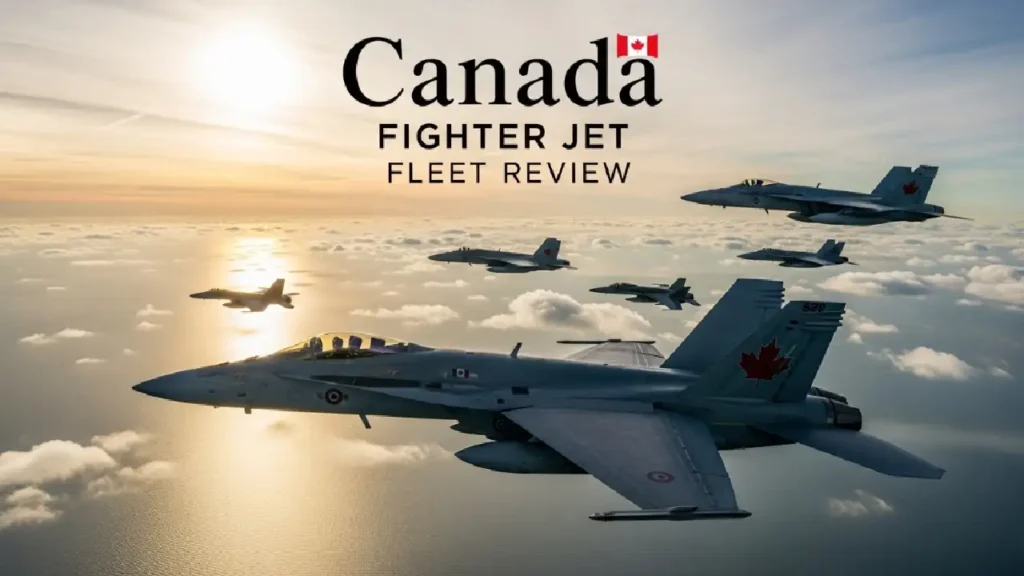
Canada fighter jet fleet review has become an important topic as the country continues to modernize its air defense capabilities. With evolving global security challenges, Canada is focusing on upgrading its fighter aircraft to maintain sovereignty, fulfill NATO commitments, and respond effectively to threats in North America and beyond.
This detailed review explores Canada’s current fighter jet fleet, upcoming upgrades, strengths, limitations, and future plans. It provides clear, factual, and well-researched insights to help readers understand the current state of Canada’s air power.
Overview of Canada’s Current Fighter Jet Fleet
The backbone of Canada’s air combat capability is currently based on the CF-18 Hornet fleet. These aircraft have served for decades and have undergone several upgrades to remain operational and relevant.

Although reliable, these jets are nearing the end of their lifecycle. As a result, Canada has initiated plans to replace them with next-generation fighter aircraft to ensure long-term security and performance.
CF-18 Hornet – The Backbone of Canadian Air Defense
The CF-18 Hornet has been a key part of Canada’s air force since the 1980s. Known for its versatility and reliability, it has played a role in both domestic defense and international missions.
Over time, Canada has invested in modernization programs to extend the life of these aircraft. Upgrades include improved radar systems, enhanced avionics, and better communication tools.
| Specification | CF-18 Hornet |
|---|---|
| Role | Multi-role Fighter |
| Top Speed | Mach 1.8 |
| Range | Approx. 2,000 km |
| Engine | Twin-engine |
| Service Entry | 1982 |
| Status | Active (Being Phased Out) |
Challenges Facing the Current Fleet
While the CF-18 fleet has served effectively, several challenges have emerged in recent years. These challenges highlight the need for modernization and replacement.
Key issues include aging airframes, increasing maintenance costs, and limitations in handling modern threats. Advanced adversary aircraft and evolving warfare technologies require more sophisticated capabilities.
Canada’s Fighter Jet Replacement Program
To address these challenges, Canada launched a competitive process to select a new fighter aircraft. After careful evaluation, the country selected the F-35 Lightning II as its future fighter jet.
This decision reflects Canada’s commitment to enhancing its defense capabilities while ensuring compatibility with allied forces. The new jets are expected to significantly improve performance, stealth, and operational efficiency.
F-35 Lightning II – The Future of Canada’s Air Force
The F-35 represents a major leap forward in fighter jet technology. It is designed for modern warfare, offering advanced stealth features, superior situational awareness, and cutting-edge avionics.
Canada plans to gradually introduce these aircraft while phasing out older jets. This transition is expected to strengthen national defense and support international missions.
| Specification | F-35 Lightning II |
|---|---|
| Role | Fifth-Generation Stealth Fighter |
| Top Speed | Mach 1.6 |
| Stealth Capability | Yes |
| Advanced Sensors | Integrated Sensor Suite |
| Operational Range | Approx. 2,200 km |
| Status | Planned Deployment |
Strategic Importance of Fleet Modernization
Modernizing the fighter jet fleet is not just about replacing old aircraft. It is a strategic move that ensures Canada can respond to future threats effectively.
New-generation fighters enhance surveillance, intelligence gathering, and combat capabilities. They also strengthen partnerships with allied nations through interoperability.
Role in NORAD and NATO Operations
Canada plays a crucial role in the North American Aerospace Defense Command (NORAD). Fighter jets are essential for monitoring and defending North American airspace.
Additionally, Canada contributes to NATO missions. Modern fighter jets enable the country to participate effectively in global security operations.
Budget and Investment Considerations
Upgrading a fighter jet fleet requires significant investment. Canada has allocated substantial funds to ensure a smooth transition to modern aircraft.
While costs are high, the long-term benefits include improved defense capabilities, reduced maintenance expenses, and enhanced operational efficiency.

Timeline for Transition
The transition from CF-18 to F-35 is expected to take several years. This gradual approach ensures that Canada maintains continuous air defense capabilities during the upgrade process.
Training, infrastructure development, and logistical planning are key components of this transition. These steps are essential for maximizing the effectiveness of the new fleet.
Strengths of Canada’s Fighter Jet Strategy
Canada’s approach to upgrading its fighter fleet has several strengths. The focus on advanced technology ensures long-term relevance in modern warfare.
Additionally, alignment with allied systems improves coordination and operational efficiency. This is particularly important for joint missions and international cooperation.
Potential Risks and Considerations
Despite the benefits, there are challenges associated with transitioning to a new fleet. These include high costs, training requirements, and potential delays in delivery.
Careful planning and management are essential to ensure that these risks are minimized and that the transition is successful.
Future Outlook of Canada’s Air Power
The future of Canada’s air force looks promising with the introduction of next-generation fighter jets. These aircraft will enhance the country’s ability to respond to emerging threats.
Continued investment in technology, training, and infrastructure will be critical in maintaining a strong and capable air defense system.
Conclusion
The Canada fighter jet fleet review highlights a critical period of transition and modernization. While the CF-18 has served the country well, the move toward advanced fighter jets marks a new era in defense capability.
With strategic planning, investment, and modernization, Canada is positioning itself to meet future challenges effectively while maintaining strong partnerships with global allies.
FAQs
1. What fighter jets does Canada currently use?
Canada currently uses the CF-18 Hornet as its primary fighter aircraft.
2. Why is Canada replacing the CF-18 fleet?
The CF-18 jets are aging and require replacement to meet modern defense needs and technological advancements.
3. Which aircraft will replace the CF-18?
Canada has selected the F-35 Lightning II as the replacement for its current fleet.
4. When will the new fighter jets be deployed?
The deployment will occur gradually over several years as part of a phased transition plan.
5. What benefits do new fighter jets provide?
New jets offer improved stealth, advanced sensors, better performance, and enhanced compatibility with allied forces.


Hi, I’m Anas — the mind behind Business Insider. I started this platform to share my interest in business and finance in a way that’s simple, honest, and actually useful. I enjoy breaking down complex ideas into something anyone can understand, whether it’s about making money, managing it, or growing a business. Through this site, I aim to provide practical insights, real knowledge, and content that genuinely helps people move forward.